
What Makes V-Type Powder Mixers Suitable for Gentle Blending Applications
Not every powder mixing process requires intensive mechanical action. In some applications, the main challenge is combining ingredients evenly without damaging fragile particles, changing their physical characteristics, or creating excessive fines. V-type powder mixers are designed to support this kind of blending through a rotating vessel that repeatedly divides and recombines the material. Their operating principle makes them a practical option for manufacturers who need uniform powder distribution with relatively gentle handling. A V-type powder mixer consists of two cylindrical sections joined at an angle to form a V-shaped chamber. As the vessel rotates, the powder moves between the two arms and repeatedly separates before coming together again. This continuous redistribution allows different ingredients to mix without relying on high-speed blades or aggressive mechanical shear. The resulting movement is particularly useful when the formulation requires consistent blending but does not need intensive particle size reduction.
One important advantage of this design is its relatively simple mixing mechanism. Unlike mixers that depend on rotating paddles or ribbons inside a stationary chamber, a conventional V-type mixer uses the movement of the entire vessel to redistribute material. With no internal mixing blades in the main chamber, there are fewer internal components that can create localized mechanical stress or trap product. This can also simplify cleaning and inspection between batches. The repeated division and recombination of powder helps distribute ingredients throughout the batch. During rotation, material moves toward the lower part of the vessel, separates into different flow paths, and recombines as the chamber continues turning. With suitable operating conditions, this process can produce a uniform blend without subjecting the entire batch to unnecessarily intense agitation. The actual result depends on the powder properties, loading level, rotation speed, and mixing duration.
V-type mixers can be particularly useful when a formulation contains ingredients with similar flow behavior but different proportions. For example, a small quantity of a functional additive may need to be distributed throughout a much larger quantity of base powder. Repeated redistribution helps bring the ingredients into contact across the batch. However, very small additive concentrations may require a carefully developed loading and mixing procedure to achieve the desired uniformity. Particle fragility is another reason manufacturers may consider this equipment. Some granules can break apart when exposed to excessive impact or shear, potentially changing the finished product's flowability, appearance, or performance. A V-type mixer can offer a gentler alternative to more aggressive mixing systems when its speed and operating conditions are appropriately selected. Nevertheless, fragile materials should still be tested because particle damage can occur through repeated collisions even in relatively gentle mixers.
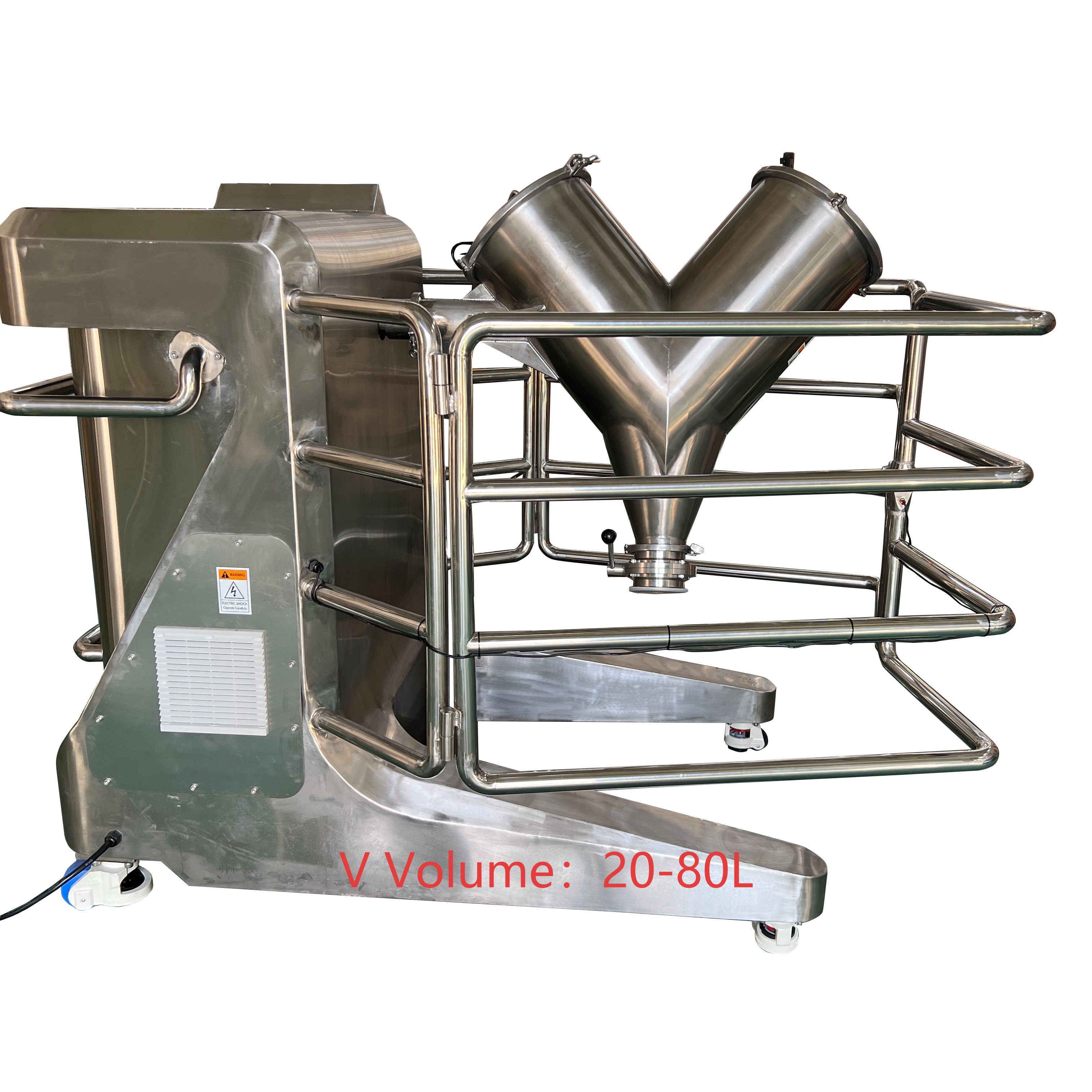
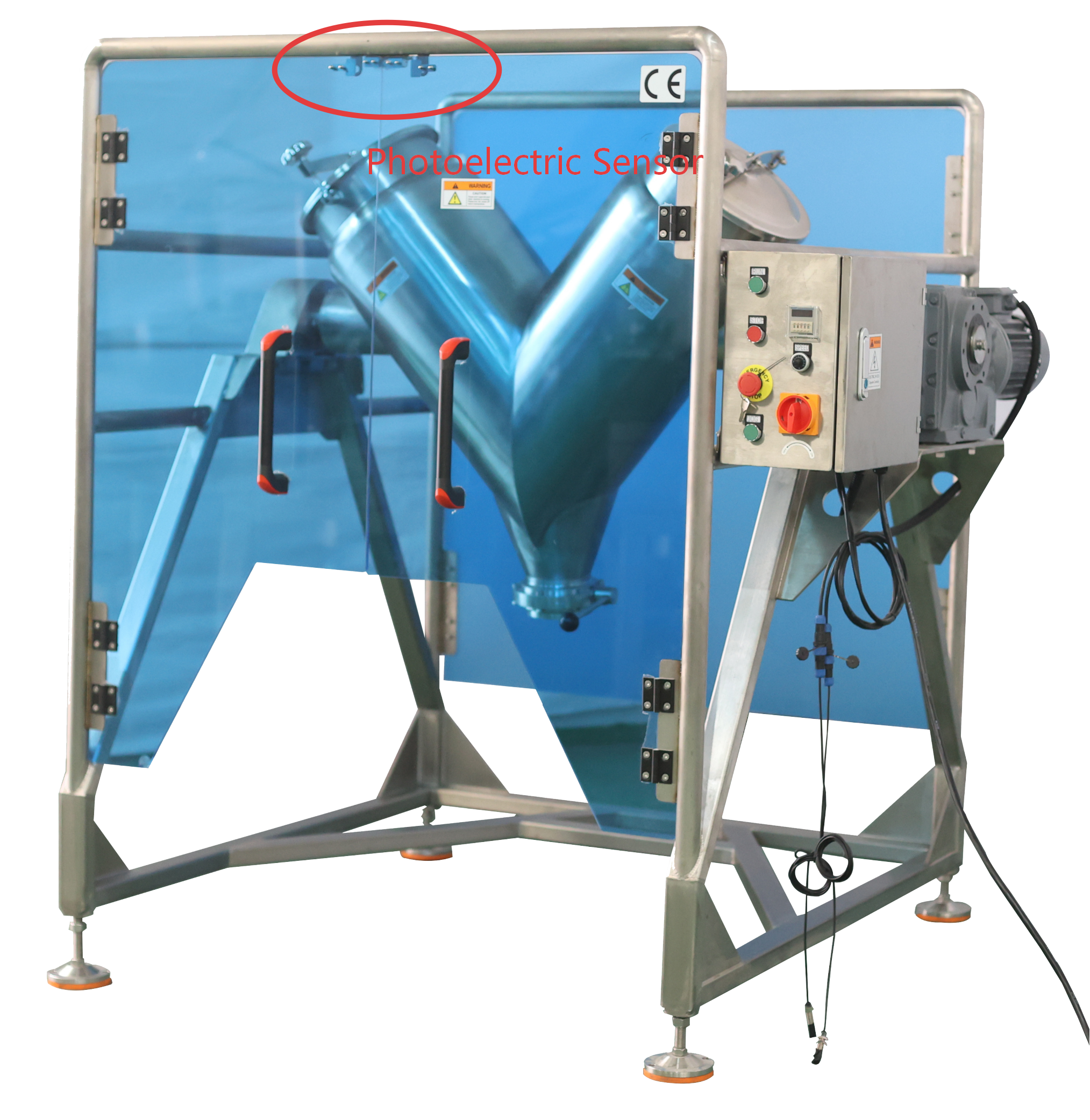
The shape of the vessel also influences how the material moves. As the V-shaped chamber rotates, the powder repeatedly changes direction, creating opportunities for redistribution between different regions of the batch. This differs from mixing systems in which material follows a more continuous circulation path around fixed internal blades. The V-type configuration is therefore worth considering when the process benefits from repeated splitting and recombination rather than intensive mechanical working. Another practical consideration is product cleanliness. Since conventional V-type mixers have no internal agitator shaft or mixing blades, the main chamber can be easier to access for cleaning. This may be beneficial for pharmaceutical ingredients, food powders, cosmetic materials, and specialty chemicals that require frequent product changes. Appropriate surface finishing, discharge design, sealing, and cleaning procedures remain essential, especially where hygiene or cross-contamination control is important.
However, V-type mixers are not suitable for every powder. Materials with strong cohesion, high moisture content, or a tendency to form lumps may not redistribute effectively through vessel rotation alone. Powders with substantial density differences can also segregate instead of forming a stable, uniform blend. In these cases, a paddle mixer, ribbon blender, or another mixing technology may be more appropriate, depending on the material characteristics and process objectives. The operating parameters should be selected according to the formulation rather than simply maximizing the mixing time. Excessive rotation or prolonged blending can sometimes encourage segregation, particularly when ingredients differ significantly in particle size or density. Similarly, overfilling reduces the free space needed for material movement, while underfilling may limit effective interaction between the ingredients. Establishing an appropriate loading range and testing the blend at different stages can help identify a suitable operating window.
When selecting a V-type powder mixer, manufacturers should evaluate batch size, bulk density, particle characteristics, required blend uniformity, discharge requirements, and cleaning expectations. The usable working volume is especially important because the vessel needs sufficient space for the powder to move during rotation. For industrial production, the mixer must also fit into the wider process, including material feeding, transfer, weighing, and downstream packaging. For manufacturers handling delicate or free-flowing powders, a V-type mixer can provide a practical balance between blending performance and gentle material handling. Its rotating vessel promotes repeated redistribution while keeping the internal mechanism relatively simple. Changzhou Zhoucheng Stainless Steel Products Co., Ltd. offers powder mixing equipment for different production requirements, and choosing the appropriate mixer begins with understanding the actual behavior of the material. With suitable equipment selection and process testing, gentle blending can support consistent product quality without introducing unnecessary mechanical stress.