
How Mixing Blade Clearance Affects Powder Movement Inside a Mixer
Mixing blade clearance is one of those details that can be easy to overlook when selecting or designing a powder mixer. The distance between the blades and the surrounding mixer surfaces directly affects how powder moves through the working chamber. If the clearance is too large, some material may escape the main mixing action and remain poorly circulated. If it is too small, the mixer may require more precise fabrication and may face greater mechanical demands. Inside a powder mixer, the blades need to create enough movement to continuously lift, push, fold, or redistribute the material. Clearance determines how closely this action takes place near the chamber walls, bottom, and other internal surfaces. This becomes particularly important when working with fine powders, cohesive materials, or formulations containing ingredients with noticeably different flow characteristics.
When the blade-to-wall distance is relatively large, powder can accumulate in areas where the mixing force is weaker. Material near the bottom or sides may move more slowly than the main batch, creating what are effectively low-circulation zones. Over repeated production cycles, these areas can contribute to uneven blending, especially when the formulation requires a high degree of uniformity. Reducing the clearance can bring the mixing action closer to the chamber surface. As the blades pass through the powder, they can move material that might otherwise remain relatively stationary. This can improve overall circulation and help reduce residual material. However, smaller clearance is not automatically better because the appropriate distance depends on the mixer design, powder characteristics, blade geometry, and manufacturing tolerances.
Powder properties play an important role in determining the practical clearance. A free-flowing granular material may move readily through a relatively open mixing environment, while a cohesive powder can stick to surfaces or form compacted areas. Fine powders may also behave differently from larger particles because of their greater tendency to agglomerate or adhere to equipment surfaces. Blade shape and clearance must therefore be considered together. A paddle, ribbon, or other mixing element creates a different movement pattern inside the chamber. The same clearance dimension can produce different results with different blade geometries. Engineers need to consider how the blade interacts with the powder rather than evaluating the distance as an isolated specification.
Clearance also affects the risk of material accumulation. If powder repeatedly settles in a difficult-to-reach area, it can increase product loss and make cleaning more time-consuming. This is especially relevant for applications that process expensive ingredients, require frequent product changeovers, or have strict cleanliness requirements. A suitable internal configuration can help improve material recovery while making the mixer easier to maintain. For cohesive powders, insufficiently controlled clearance can also contribute to buildup on internal surfaces. Once a layer of material begins to form, it can change the effective geometry of the mixing chamber and further alter powder movement. Over time, this may reduce the available mixing volume and create additional cleaning requirements.
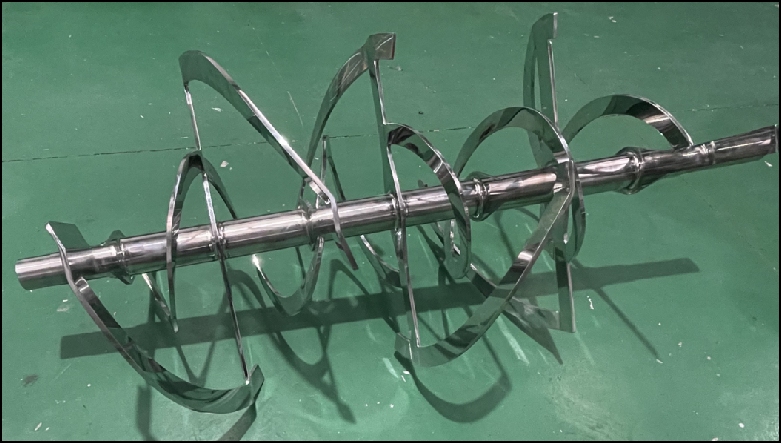
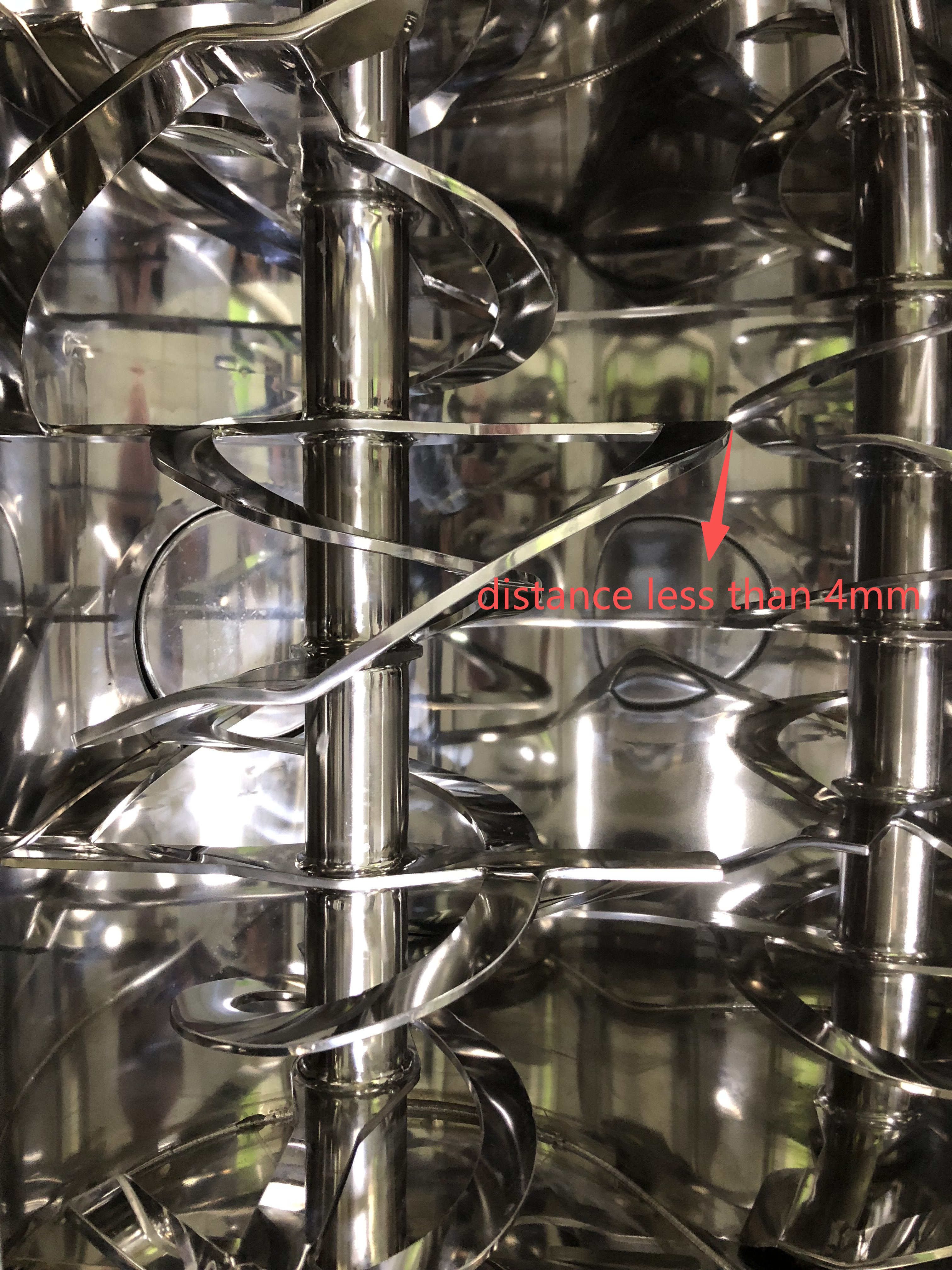
At the same time, reducing clearance too aggressively can introduce other concerns. Mixing blades rotate close to the mixer body, so dimensional accuracy and shaft stability become important. Thermal expansion, mechanical deflection, vibration, and manufacturing tolerances may all need to be considered. The clearance must provide reliable operation throughout the expected working conditions rather than only under static conditions. The effect becomes even more noticeable in mixers with complex internal configurations. Double-shaft paddle mixers, for example, require appropriate relationships between the two shafts, their paddles, and the chamber walls. The movement generated by the two shafts needs to remain effective without creating interference between rotating components. Proper spacing is therefore part of the overall mechanical design.
Clearance can also influence discharge performance. After mixing is complete, the blades continue to move material toward the outlet. If the internal geometry leaves significant dead areas around the bottom or sides, some powder may remain after discharge. This can reduce usable yield and make the following cleaning or batch changeover more difficult. For this reason, mixer selection should not be based only on capacity, motor power, or mixing speed. Blade configuration, chamber dimensions, internal clearance, discharge arrangement, and material characteristics all contribute to the final mixing behavior. A machine that appears suitable based on capacity alone may perform differently when used with a particular powder.
When designing a custom powder mixer, manufacturers can evaluate the material's particle size, density, moisture content, flowability, cohesiveness, and required mixing uniformity before determining the internal configuration. These factors help establish a suitable relationship between the blades and mixing chamber. For applications involving different powders or changing batch sizes, the design may also need to accommodate a broader operating range. A well-designed powder mixer uses clearance as part of the overall material-flow strategy rather than treating it as a simple mechanical gap. The goal is to keep powder moving through the active mixing zone while limiting stagnant areas, buildup, and unnecessary mechanical stress. For customized powder mixing equipment, careful attention to blade geometry and clearance can therefore contribute to more consistent blending, easier discharge, and more practical day-to-day operation.